a courtier of a house whose office has the guard right
on the house's land, including land it has given in fief
a faction member
on land the faction holds, or that a house has hired it to keep
the headman and the village's lord
on that village's land
A new house has the guard right in the offices of marshal and head of the house, and the head can give it to other offices (Noble houses and court).
Hiring a faction to keep a land is a matter of treaties. Nobody keeps the guard on free land.
Duty for a faction or a house that earns pay gives no guard rights. Only the land you stand on counts.
A guard who steps off the land of their house or faction cannot put on new bonds.
Whoever does not keep the guard ties only with consent: H, "Tie with consent" (Tying by consent). A rope like that can be slipped.
Hands up
With your hands up you can walk, but you cannot attack, use items, open doors or chests, mount a horse or trade.
What a guard can do
On the wheel
On whom
What it does
"Detain"
someone standing who has not raised their hands
holds them in place, time enough to bind them
"Bind"
hands up, downed, unconscious or detained
ties their hands
"Lead", "Let go"
bound, on their feet
leads them behind the guard
"Search"
surrendered, downed, detained, bound or in the stocks
shows the purse and bag, takes nothing
"Gag"
someone who cannot defend themselves
the voice drops to a whisper at most
"Slap"
bound, outside the stocks
a gesture only, no harm
"Put in the stocks", "Let out of the stocks"
bound, by the pillory
described below
"Lead to the stable"
another's horse nobody sits on, its owner not nearby
the horse goes back to its own stable with its saddlebags, free, and the owner gets a message
A guard does all of this with H on the person or the horse, up close and with free hands.
Over someone not bound, "Lead", "Slap" and "Put in the stocks" show greyed out with "This person must be bound.".
A guard cannot detain or search a staff member on duty, someone in a duel, or a member of their own party.
Detaining and binding
A bound person can walk and speak, but cannot fight, use their hands or items, open doors, mount a horse or trade.
The guard or whoever tied them can untie them.
A guard leads or holds one person at a time.
Wrest free
While a guard holds you, "Wrest free" appears in F1. It is the same struggle as against a rope tied by consent, but with a chance of 10 % at most.
Out of the guard's bonds you break free only 5 min after the tying, and only while no guard stands within 20 m ("Try to break free"). Not out of the stocks.
Searching
"Search" opens a window for the guard with the purse and every item in the bag, keys, letters and seals included.
What the guard confiscates you agree by voice and hand over through the exchange, and a bound person must be untied for that.
The gag
Anyone with free hands can take the gag off: H, "Remove the gag". You take out your own in F1, "Take out the gag", as long as your hands are free.
The stocks
Bring the bound person to the pillory, within 5 m of the stocks.
H on the prisoner, "Put in the stocks", and pick the time.
A pillory with stocks stands on the square in Troskowitz and below Nebakov fortress.
A guard can let them out early with "Let out of the stocks", and the hands stay bound either way.
Anyone with tied hands can be put in, including after a tying by consent.
When a courtier ends up in the guard's stocks, their house loses 1 pts of reputation with the lord.
Chores
Chores
a pile cuts the sentence by
15 s
The village's headman and its lord judge, meaning the house that holds the village (the head and the courtiers with the right over lands), or the chief of a faction that holds it on its own. They judge only on their own village's land (Headman, council and the village's lord).
The sentence
The guard binds the culprit, or the judge does, who keeps the guard on their own village's land. A rope tied by consent has to be untied and tied again.
The judge stands by the prisoner in the village: H, "Sentence to chores", and picks the time.
Working it off
Only a convict of that village can touch the piles.
Nothing keeps the convict on the square. They can walk away, but the sentence waits for their next time in the game, and a guard who searches them sees in the window how much is left and in which village.
The sentence ends with the last pile ("Chores done. You may go."), with a pardon from a judge of that village through H, "Pardon the rest", or by decision of the staff.
The game server supplies the numbers on this page.


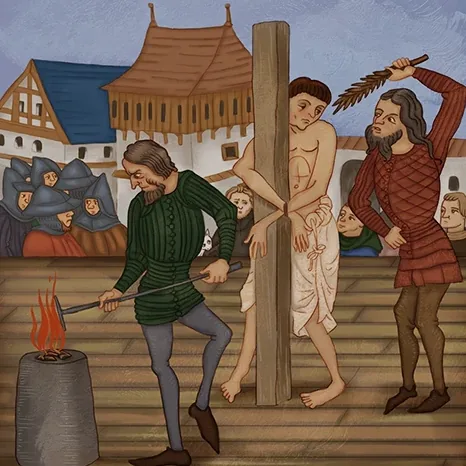 The pillory stands on the square so the whole village can see