

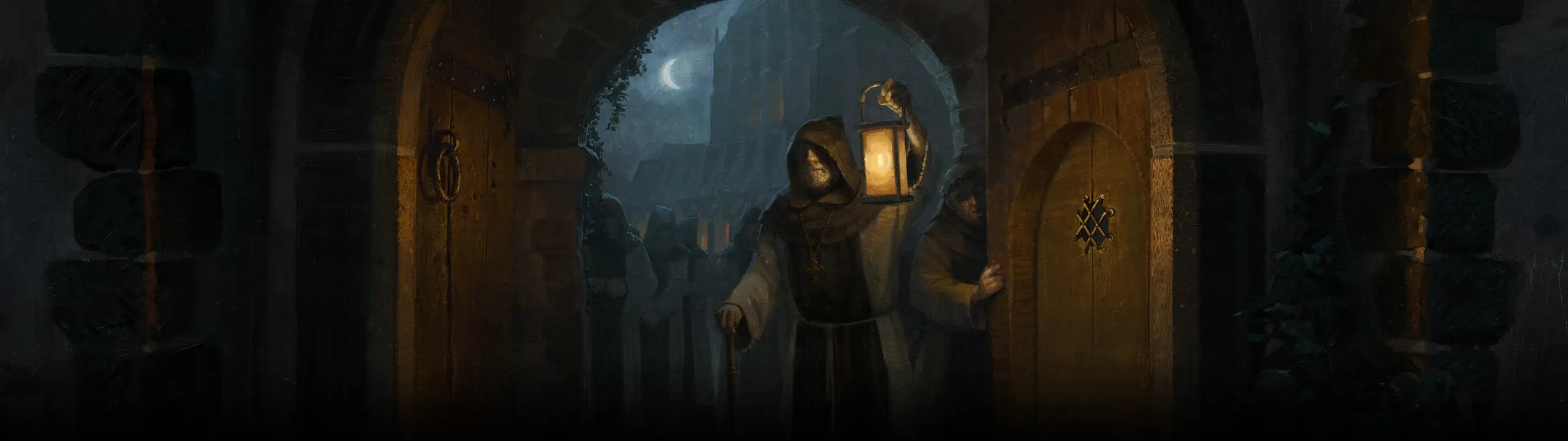
We play in Bohemia, in the year 1403.
These rules apply in the game, on our Discord and on our website. They are here so that everyone has a good time, and they bind every player from day one.
What counts is the point of a rule, not its exact wording. We cannot write down everything that might happen, so where these rules are silent, do what would be fair to the other players. The punishment depends on how serious the offence was, whether it was deliberate and whether it keeps happening: anything from a warning to a ban.
I.Bohemia, 1403
You play someone living in Bohemia in 1403: a local, or someone from further afield, from lands Europe knew at the time. Your character speaks, thinks and behaves like a person of that age and knows only what such a person could know.
There is no magic in this world and there are no made-up lands. Nor do you deny what has already happened in the story we share.
Examples of things that do not exist yet in 1403:
- today's words and sayings from the internet,
- the printing press, pocket watches and other later inventions,
- potatoes, tobacco and coffee, which nobody in Bohemia has heard of yet.
II.Name and character
The character's name fits the period and Bohemia. Good examples: Jan of Rattay, Jan the Smith, Marketa of Sasau.
No names of famous characters from games, books or films, no names of real, well-known people, past or present (kings, princes, famous knights and nobles, politicians, celebrities, streamers), no joke names, no swearing and no internet nicknames.
If your character's name breaks these rules, the staff will ask you to make a new character.
III.What we do not play
The Middle Ages can be brutal, but these we never play out:
- sexual violence,
- torture and mutilation described in detail without the other player's out-of-character consent,
- racism, Nazi symbols and hatred of real groups of people,
- references to other players' real lives.
Erotic scenes are allowed only with the consent of everyone taking part, and only out of the way, where nobody else is around. In the middle of a village or anywhere else in plain sight they are forbidden.
Faith, the Church and the religious disputes of the age are part of the world, but they are not for insulting real faiths.
IV.Voice and chat
In the game you talk by voice, always in character. No music, soundboards or voice changers.
The text chat is out of character (OOC). Only players nearby read it, as far as normal speech carries. It is for technical matters: that you have to step away, that something does not work, that a scene has to stop. You do not write in the chat about what happens in character.
The exception is the /me and /do commands. During a roleplay scene you use them to describe what your voice cannot carry, such as a look, a smell or a gesture the game does not show. You do not use them instead of talking, and you write no swear words in them.
Nor do you hide out-of-game matters inside your character's speech. This is forbidden.
V.Metagaming
Metagaming is forbidden: your character does not draw on anything learned outside the role. Discord, streams, the chat, the website and your other characters are sources for you, not for your character.
What your character lives through in the game stays in the game as well. When bandits hold your character tied up in the woods, you do not write on Discord where you are.
You see the name above someone's head; your character does not. Your character learns it only when that person introduces themselves. If they give a different name, your character goes by that name until something in the game gives a reason to doubt it.
You and your character know different things. Keep that line for as long as you play.
VI.Powergaming
Powergaming is forbidden. It comes in two forms: playing out the impossible, and deciding a scene for the other person.
The impossible is, for example, swimming across a river in full armour, bursting an oak gate open with one shove of your shoulder, or carrying a barrel of beer under your arm for half a day.
Deciding for someone is a description that leaves the other person nothing to say, such as "I hit you right in the heart" or "I throw a sack over your head and take you to our camp".
Describe what you try to do and wait for the answer, for example: "I try to slam the door in your face. Do you get your foot in?". When the game has its own action for something, such as cuffs or a gag, you use it instead of a description.
What is in your inventory your character really carries. You do not play out hiding an item that is in your inventory, nor having something that is not there. Fights run on the game's mechanics and you do not need to describe them.
VII.Attacks without a reason
An attack, a brawl or a killing needs a reason that arose in the game. Without one you do not beat or kill anyone. Nor may you needle someone on purpose so that they start it and hand you an excuse to kill them.
Examples of attacks without a reason:
- beating a passer-by because you feel like a fight,
- jumping the first traveller you see because "that's what bandits do",
- killing someone on the road without a word, just to search them,
- revenge in character for something someone did out of character.
VIII.Robberies and swindles
Robberies and swindles belong to this world, but they should lead to stories, not to quick money. Whoever robs or swindles keeps to every limit below.
You choose a victim by what can be seen and heard: a good cloak, a full purse at the belt, a horse, armour or boasting in the tavern. Someone who shows no wealth at all is not robbed.
Where and when:
- You rob in lonely places: on the road, in the woods, in the fields between villages. In towns, in villages and wherever people gather, such as the market, the tavern or the church, you neither rob nor swindle.
- You rob at most once every 30 minutes. Everyone beaten in one scene counts as one robbery, so you may rob each of them.
- You rob on foot: before you rob anyone, you get off your horse or cart.
What you take:
- The whole purse or at most two items, never both. A stack, of arrows for example, is one item.
- By words or threats you get at most 100 gr out of one person, in coin or in goods. This limit does not apply to robbery.
What you do not do:
- You do not make anyone take money out of the bank.
- A robbed victim stays alive unless the game gives a truly weighty reason to kill them. Fear of being recognised is not enough.
- Your own business is not a tool for robbery: you do not rob or swindle the customers of your workshop, stall or tavern.
The exception: from someone who robbed or swindled you before, or stole from your house, your business or a place you truly guard, you may take back what they took. If it is gone, you take groschen or goods of the same worth. You must prove it is the same person, though. Without proof there is no exception.
IX.Valuing your life
Your character wants to live. When there is something to fear, they are truly afraid, even if that means losing the scene.
Three men with drawn swords are a reason to hand over your purse, not to throw yourself at them bare-handed. So is a crossbow aimed at you from a few paces.
A defeat can make a good story too, and a good story is worth more here than any loot.
X.Knocked out and killed
When your character is knocked out or killed in a scene, the game goes on. A permanent character kill (CK) is something else, and it is rare.
After being knocked out or killed in a scene, your character remembers nothing of the whole affair or of its causes. You go back to that place no sooner than 15 minutes later, and only once the scene is over.
For example: you and your companions waylay a merchant below Trosky and his men bring you down. When you come to, you do not know who beat you or whether your companions got away with the loot.
A permanent death closes the character's story, and nobody plays them again. A death in a scene never becomes permanent by itself. Only the staff decide on it, at a player's request, and an ordinary grudge, say over a stolen hen or a lost brawl, is not enough. You may also ask for a permanent death for your own character.
When you start a new character after a permanent death, they know none of the people or affairs of the old one. They learn everything anew, in the game (rule 5).
XI.Leaving the game
You do not leave the game to avoid the consequences of a scene: capture, robbery, a fight or a punishment.
If you really have to leave in the middle of a scene, say so briefly in the chat before you go. Then arrange with the others to finish the scene another time. If you get disconnected by accident, come back as soon as you can or let others know on Discord.
XII.Game bugs and mods
You do not use game bugs or server features for something they are not meant for. When you come across a bug, you report it to the staff on Discord and leave it alone. For example: a way to double your groschen, an item that can be sold twice, or hiding inside walls.
You use no cheating programs, macros or mods that give you an edge over others, such as ones that do your work for you or show people behind walls.
You have one account. You do not lend it, give it away or sell it.
XIII.Real money
You do not sell or buy anything from the game for real money: groschen, items, horses, houses, plots or characters. The server's groschen and things have no value outside the game. Both sides of such a trade get a ban.
Dice and other games for groschen are part of the world. You play only for the game's groschen and things, never for real money, and you do not exchange winnings for anything outside the game.
XIV.Good manners between players
Your character may lose their purse, their pride, even their life. That happens to the character, not to you, so you do not take it personally or get back at the player.
Out of character you treat others with respect. Insults, harassment, discrimination and the like are forbidden in the game, in the chat, on Discord and wherever our community meets.
Someone else's offence gives you no right to one of your own. You play the scene to its end and report the matter afterwards: in the game on the Reports card under F2 (or with /zglos), or on Discord. Add a recording or a screenshot if you have one: the staff decide on what they can see.
If the report holds up, the staff repair the harm done by someone else's offence: they give back what was lost and help set your character's story straight.
XV.Disputes and the staff
You settle disputes after the scene, always with a member of the staff, on Discord or in the game. You do not settle them in the middle of play, nor privately with the other side.
You carry out the staff's instructions at once and respect their decisions, even when you think they are wrong. You may appeal against them on Discord: the appeal goes to someone on the staff other than the person who decided, and they may change the decision.
When the staff step into a scene, everyone stops it at once. The staff may void a scene and ask for it to be played again. You reach the staff in the game through the Reports card under F2 (or /zglos) or with a ticket on Discord, not with private messages to a particular person.
Every new player reads these rules in the game and passes a short quiz before making a character.